
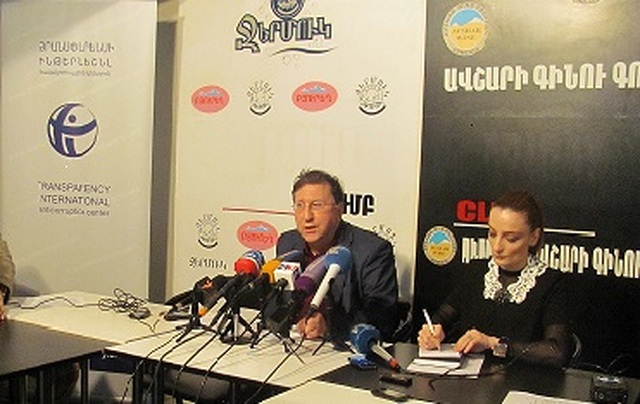
TIAC Press Conference at Friday Press Club: the current corruption situation in Armenia
On December 9, 2014 Varuzhan Hoktanyan, Executive Director of Transparency International Anticorruption Center presented corruption situation in Armenia during a press conference at Friday Press Club. He noted that, as in previous years, Armenia failed to make considerable progress in fight against corruption. It is based on the objective facts that can be seen in TI Corruption Perceptions Index, World Bank’s the Worldwide Governance Indicators (WGI) project's Control of Corruption dimension and Freedom House Nations in Transit report's Corruption Rating and other surveys. The progress is very little, within statistic margins of error. It is mainly conditioned by more active investment of e-Government, which though reduces corruption risks, fails to abruptly reduce corruption.
According to Hoktanyan, the drastic, deep-rooted causes for corruption are:
- convergence of business and political elites,
- high level of monopolization in economy and politics, which brings to monopolization in political field,
- lack of independence of judiciary,
- high level of tolerance of corruption in the society.
There is a concern that the situation might be deteriorated, considering Armenia's accession to the Eurasian Economic Union (EEU), an alliance of three member states namely Russia, Kazakhstan and Belarus, with higher level of corruption than that of Armenia’s. If hitherto Armenia’s authorities had to carry out reforms within the framework of cooperation with European Union, there is no such obligation in the new club. Armenia’s geopolitical choice does not provide grounds for optimism. Varuzhan Hoktanyan was rather skeptical about Armenia’s becoming an anti-corruption leader and Russia, Kazakhstan and Belarus’s improving their TI CPI scores. He rather sees danger that the contrary might happen.