
Issues related to shadow economy
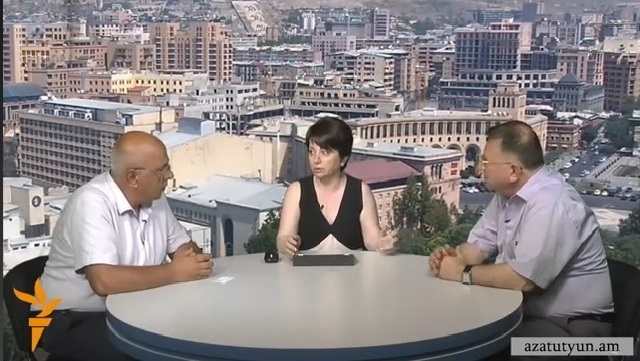
On August 23 Varuzhan Hoktanyan, Executive Director of Transparency International Anticorruption Center and Asot Yeghiazaryan, Economist, Associate Professor of Armenian State University of Economics were the guests of Radio Liberty's "Tesaketneri Khachmeruk" (A Crossroads of Viewpoints) program, hosted by Anna Israyelyan. They talked on issues of shadow economy in Armenia by addressing how realistic reducing the shadow economy in 100 days might be, the problems caused by the “shadow,” its causes and ways to tackle it.
During Government meeting held on May 15, 2014, Prime Minister Hovik Abrahamyan referring to his previous day’s meeting with entrepreneurs said: “We agreed that we all must work in the same field, doing our best to come out of the “shadow.” That was our condition. The entrepreneurs will be given the opportunity up till July 1 to set up a level playing field on their own. I do believe that they should try to follow the rules of the game. If not, we will have to use the necessary leverages to achieve our goal.” However lately the Prime Minister had to confess during Pan-Armenian youth gathering “Baze 2014” that more time was needed to solve the issue.
According to Varuzhan Hoktanyan from anticorruption point of view shadow economy is a serious problem, and only in case of systemized approach and coordinated struggle may the goal of reducing the “shadow” be achieved. In view of international experience and Armenia’s specificity expecting to reduce “shadow” in hundred days would be idealistic. Years if not decades are needed to reduce the “shadow,” since in addition to economic measures, serious changes are required to bring about in political system and in social policy.
Naturally some measures have been taken in fight against reducing “shadow.” The issue is how such measures may bring about a situation leading to positive change. Episodic cases of arresting some officials are not enough to settle the issue. Not only punitive measures shall be taken. Preventive system should exist with preventive potential in order to prevent the “shadow.” The problem is how stable the fight against shadow would be and how it would continue. Another problematic issue is people’s tolerance of corruption and of “shadow.” Taking into consideration the specificity of the regime reducing “shadow” may be achieved either by transfer of power or by manifestation of political will as it happened in Georgia after the change of power.
The data published by the Ministry of Finance provides interesting idea on the size of shadow economy. Accordingly, the turnover of goods not documented was reduced by 50 percent. The number of invoices were increased. In the opinion of Varuzhan Hoktanyan judging by invoices is not the only variable to measure shadow economy. It is questionable how reliable the data on the measuring “shadow” (30-35 percent), the data on invoices were, how the prices of goods being imported complied with actual prices.
Still in November 2011, speaking at the congress of the Union of Manufacturers and Businessmen of Armenia, President Serzh Sargsyan stated that business should consistently be separated from the state system and the power. Pursuant to Varuzhan Hoktanyan in the case of Armenia one of the root causes of corruption was the convergence of business and politics. It is manifested by state capture, when certain financial, manufacturing groups shape the emerging laws and sub-legislative acts to their own, very substantial advantage. According to the latest Business Environment and Enterprise Performance Survey (BEEPS), a joint initiative of the European Bank for Reconstruction and Development (EBRD) and the World Bank Group (the World Bank) the situation deteriorated in Armenia compared to the data in 1998 survey.