
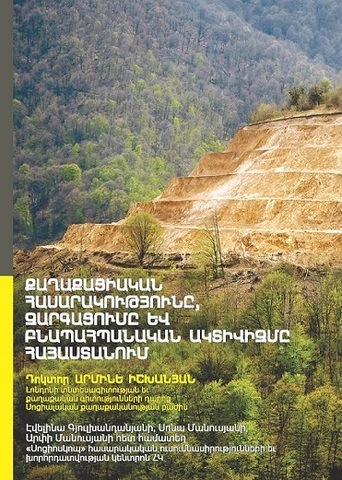
“Civil Society, Development and Environmental Activism in Armenia”
Authored by Dr. Armine Ishkanian, Department of Social Policy from London School of Economics and Political Science (LSE) with Evelina Gyulkhandanyan, Sona Manusyan, Arpy Manusyan, Socioscope Societal Research and Consultancy Center NGO, a report “Civil Society, Development and Environmental Activism in Armenia” where Transparency International Anticorruption Center had a contribution was released last year. Through an examination of recent environmental activism in Armenia, this report highlights the achievements as well as the challenges and obstacles facing civil society in Armenia.
The objective of the report is to contribute to on-going debates within Armenia and in diaspora communities around the globe about mining in Armenia, but also about the wider socio-economic and political developments in the country.
The report addresses the following questions:
- What factors have led to the rise of the civic initiatives in Armenia in the past 5 years? And what are environmental civic initiatives trying to achieve?
- What direct and indirect impacts have environmental civic initiatives had in Armenia?
- What lessons can be learned from global experience?
Civic initiatives, which began to emerge in 2007 and expanded in larger numbers in 2010-2011, have achieved important, albeit small victories on a diverse set of issues. Until 2012, in the absence of political and policy level discussions, civil society activists, working through civic initiatives and formal, professionalized NGOs, played a key role in raising awareness about and campaigning against the potential dangers posed by mining to the environment, public health and sustainable development in the country.
Despite these achievements, much remains to be done if a broader segment of the population is to be engaged. However, there are serious obstacles facing civil society organizations and activists in their efforts to ensure greater accountability, participation and transparency in policymaking processes. It is unlikely that activists working in civic initiatives alone will be able to achieve this without scaling up their efforts and broadening participation and engagement.