
The results of monitoring OGP implementation
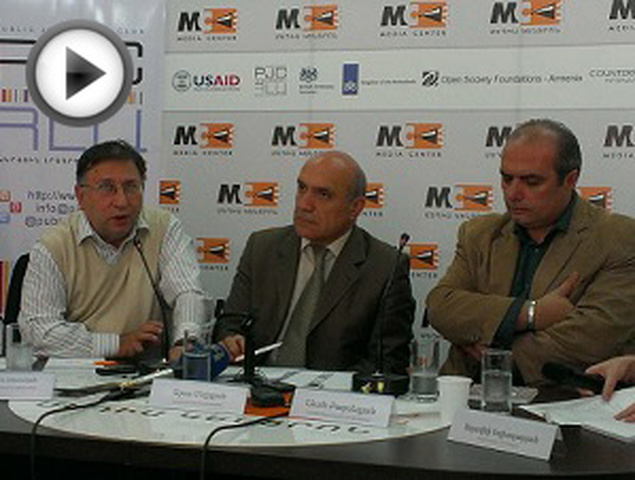
On September 15, 2013 Varuzhan Hoktanyan, Executive Director of Transparency International Anti-corruption Center and partners Ashot Melikyan, Chairman of Committee to Protect Freedom of Expression and Levon Barseghyan, Board Chairman of Journalists' Club "Asparez" of Gyumri presented the results of monitoring carried out by their organizations. They also reflected on the steps undertaken by Armenia to meet its OGP commitments, action plan for 2014-2016 by the Republic of Armenia, as well as alternative action plan developed by NGOs.
According to Varuzhan Hoktanyan Armenia officially joined the Open Government Partnership (OGP) initiative in November 2011. A working group to develop OGP Action Plan was set up in February 2012 comprised of both state institutions and civil society representatives. Upon adoption in Brazil Summit in April 2012, RA Action Plan was to take effect. TIAC undertook two commitments regarding public procurement system and anti-corruption obligations not due to a mechanism by a coordinated, defined working group but because it monitored them in the course of its projects. Those commitments were included in Actions Plan thanks to TIACs efforts.
As for Armenias commitments undertaken by procurement system Hoktanyan noted that they were formally implemented. Though electronic procurement system is operating, it is incomplete. TIAC posted three publications on its website on electronic procurements, single source procurement and appeals process. Thus, formally electronic procurement is existent but the way the system works is problematic. Second, trainings were held for various participants in procurement system. However the issue is effective they were from the point of view of their content. Third, codes of conduct were substituted considering adoption of RA Law on Public Service. In Ministries procurement specialists as public servants should apply rules of ethics. However, it does not refer to Procurement Support Center.
As of present, only one working group meeting was held so far to discuss 2014-16 Action Plan, which failed to settle issues. Representatives of various ministries and NGOs were invited to that meeting. The NGOs recommendations were practically not adopted. There is no project yet. It refers to electronic government. The authorities think that the government should extend the application of electronic government in Armenia and there was no need to include whatever was out of that sphere.
Open government model entirely complies with the declaration, which was adopted in New York on September 20, 2011 by General Assembly of the initiative. It includes four fundamental principles, the organic union of which comprises open government. RA government met only one principle out of the four - increase access to new technologies for openness and accountability. The idea of electronic government is implied in that principle. However, there are three more principles, which in case of failing to meet put the concept of open government into question. One principle is increase the availability of information about governmental activities. The public should be more informed on what the governments do. Second - support civic participation, i.e. state government should be more participatory for the principle of open government to be truly implemented. Finally, the third principle is implement the highest standards of professional integrity throughout our administrations. This implies that the system should be conscientious and meet ethics principles. Thus, it is wrong to be circumscribed by only one principle.