

Face to Face: why is fight against corruption not effective?
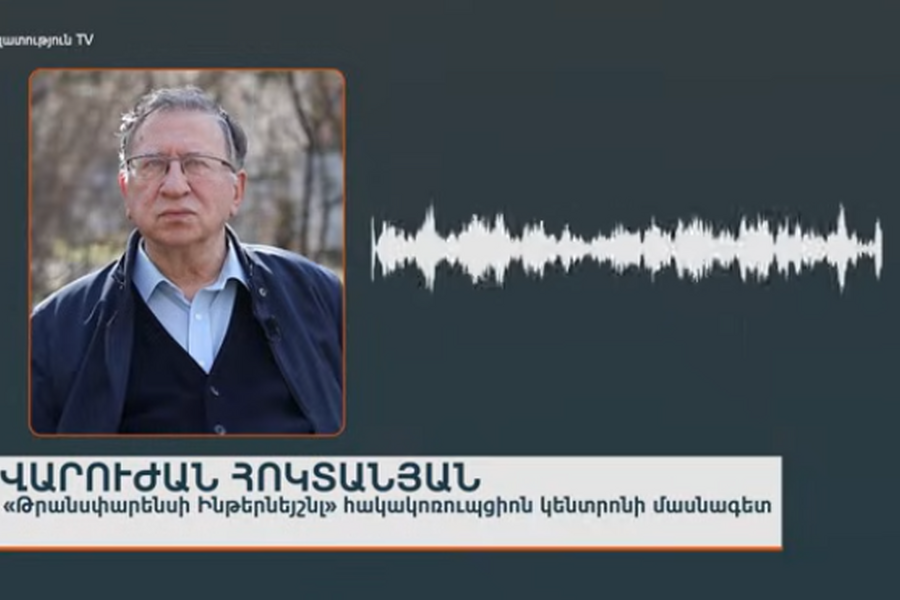
On July 20, 2012, Varuzhan Hoktanyan, Executive Director of Transparency International Anti-corruption Center and Deputy Minister of Justice Yeghishe Kirakosyan were the guests of "Face to Face" online show broadcasted live on www.aravot.am air. They debated over the issue why the government's fight against corruption was not effective despite extensive reforms and external incentives, e.g. Armenia was one of the first countries in CIS space whose government officially adopted and applied anti-corruption strategy and its implementation action plan.
Fight against corruption was stipulated as priority at least in the latest three government programs. Nonetheless reputable international anti-corruption organizations continue to rank Armenia as a country with systemic corruption. Moreover, year after year Armenia shows slow decline in its TI Corruption Perceptions Index score. According to the corruption surveys conducted by the Caucasus Research Resource Centers-Armenia trust in the anti-corruption measures taken by the government has been gradually declining.
There are three main directions of effective anti-corruption policy ? detection; prevention, law enforcement, rule of law; public support and anti-corruption education. The Republic of Armenia anti-corruption strategy and its implementation action plan for 2003-2007 was focusing primarily on legal changes, a number of legal acts were adopted. The second anti-corruption strategy for 2009-2012 was intended not only for implementation of legislative reforms but also for improving institutional capacity and providing for systemic developments. An institutional issue, lack of a permanent Secretariat, a professional agency which would have coordinated the implementation of anti-corruption strategy action plan, to some extent promoted to the failure of effective implementation of the program, including real engagement of civil society in the program implementation.
The next step after adopting legal acts was to be practical implementation of the strategic action plans and the main component was to be the establishment of the rule of law and overcoming the atmosphere of impunity. Another reason why the anti-corruption policy is not effective is because the citizens in their everyday life witness numerous cases when the corresponding authorities do not react to scandalous corruption cases. The high level of tolerance of corruption also occur because the population fail to see real willingness of authorities to detect corruption. The population saw that in the neighboring Georgia real fight started from above, by the way a very harsh fight and eventually it brought to reducing corruption. During his official visit to the Kingdom of Belgium on June 3-5, while answering the questions of interest to news reporters, Prime Minister Tigran Sargsyan said that the Armenian government intended to launch fight against corruption from above and particularly in replying why the successful attempt of Georgia to fight corruption was not being applied in Armenia, said that the revolutionary road leading to change was unacceptable in Armenia and we abide by the evolutionary path toward transformations.
According to Deputy Minister Yeghishe Kirakosyan the most important thing is reducing corruption risks in middle level for a citizen to deal with corruption as little as possible and the Armenian government took several steps to achieve that goal.
We should be careful in overcoming corruption in the middle level so that it won't reach higher level. According to Varuzhan Hoktanyan the evolutionary path would succeeded should two priority issues be settled? separation of the convergence among the political and economic elites and demonopolization of the economy. It would be difficult to overcome upper-level corruption by the evolutionary path. The evolutionary path of fighting corruption would have been effective if the law enforcement system clearly reacted to the latest allegation by Vizcon LLC founding director P. Anderson on Armenia's elite being corrupt. Overcoming small administrative corruption, for instance, reforms in the notary service, in the traffic police, etc. would not bring to drastic changes, in case of being limited only in those spheres. On the other hand, replacing the government does not necessarily mean that corruption would be reduced. Not only was corruption not reduced in Ukraine, it was increased as a result of the revolution.
Evidently, separation of the converged political and economic elites and demonopolization of the economy is an issue of priority. However there are still businessmen MPs in the National Assembly of Armenia despite the activity of the Ethics Commission of High-Ranking Officials, established in January 2012. TIAC sent official inquires to that Commission and found out that no legal proceedings regarding ethics were carried out so far.
In the opinion of Varuzhan Hoktanyan the 2012 parliamentary elections showed that the population as well was actively involved in the feast of political corruption. As a result of monitoring of various aspects of elections carried out by TIAC it was revealed that there was both supply and demand side in vote bribing. There were a number of other serious problems regarding vote registers, etc. showing the complete spectrum of political corruption. The situation was rather depressing and it was widespread. Vote bribing was large-scale and was based on mutual agreement, i.e. people did not refuse, did not deny selling their votes. We also faced the problem of institutional fear, that is people voted in fear of losing their positions in case of replacing the government. This factually shows that the public service, civil service are non perfect, and had a number of serious problems to be settled, since in case of the change of the government officials may be easily fired.