
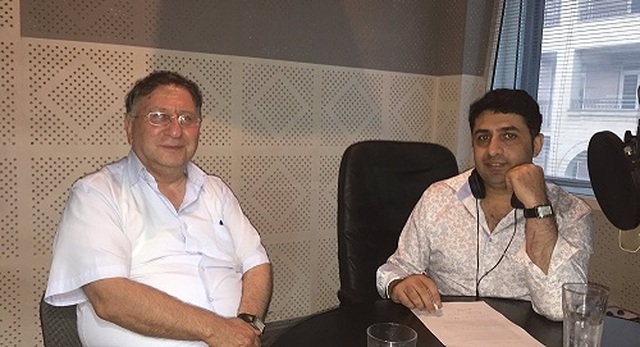
Sputnik-Armenia: The state of fighting corruption in Armenia is stably bad
The state of corruption in Armenia has stagnetd on the whole since 2003. Illustratively expressed, the state is stably bad. It was stated by Varuzhan Hoktanyan, Executive Director of Transparency International Anticorruption Center (TIAC) in his interview to Gevorg Melikyan's "Status Quo" program of Sputnik-Armenia radio by adding that, fortunately, it has not deteriorated. “Three-four years ago Armenia scored below on a scale in the ranking table of TI Corruption Perceptions Index (CPI). We have recently witnessed slight progress, which occured not because Armenia’s score rose but rather the scores of several countries fell. Armenia’s ranking did not change in 2003-2008.”
As Varuzhan Hoktanyan noted, if by another TI research, TI Global Corruption Barometer survey’s (GCB 2010) findings education was the most affected institution in the country in 2010, according to GCB 2013 results the judiciary, public officials/civil servants and medical and health services were perceived in Armenia as the most corrupt institutions/services.
To the question how TIAC built its relations with public and state institutions, whether it encountered partnership or barrier, TIAC Executive Director did not give a one sided reply. “Of course there is no barrier. There are challenges, limitations. However on the other hand there are many things to do, i.e. we state, criticize but all the same they continue what they do."
Addressing Armenian Government decision to establish an Anticorruption Council, Hoktanyan noted, “It would be ridiculous to think that the council might eradicate corruption. One should have a systemic view of the problem. The formation of a class of integrated public servants is seen as laying the basis for the Anti-corruption Concept. Naturally it is not sufficient for corruption reduction in Armenia, and there should be no illusions that anticorruption strategy might solve all the problems either.