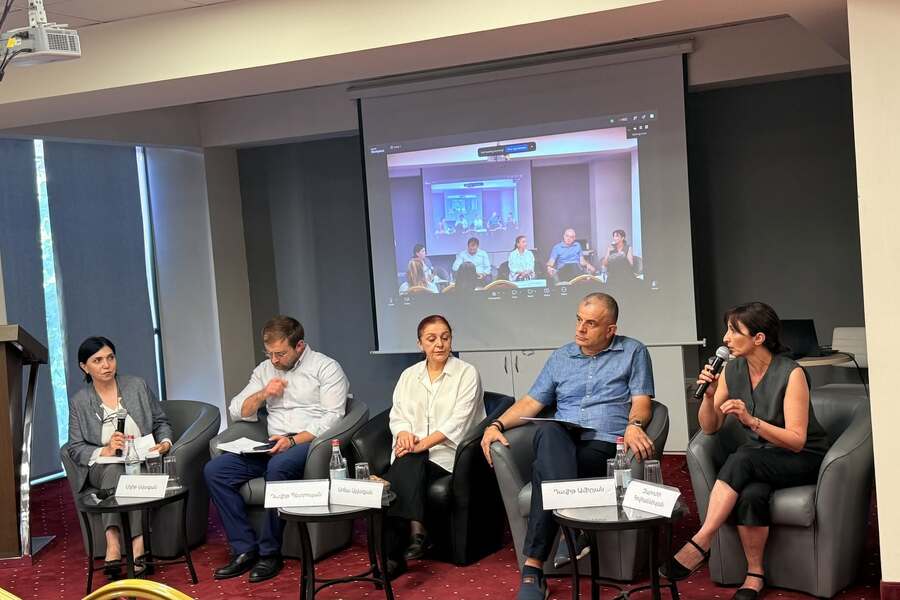

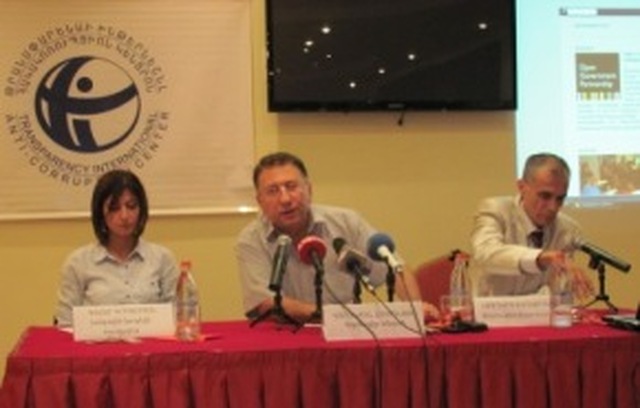
TIAC monitoring results were presented
Varuzhan Hoktanyan, Executive Director of Transparency International Anti-corruption Center (TIAC) and Expert-analyst Ludwig Khachatryan presented the results of "Electronic Monitoring of 2012 Parliamentary Elections in Armenia" project, supported by Open Society Foundations - Armenia. TIAC also presented summarized findings of another election-related project implemented by the organization, namely the monitoring of the parliamentary elections campaign finance and misuse of administrative resources of the parties (blocs), which participated at the proportional list vote of National Assembly 2012 elections.
The goal of electronic monitoring of 2012 Parliamentary Elections in Armenia was to reveal possible violations through comparative analysis of some voting numbers (for example, number of registered voters, number of voters, who actually voted, inaccuracies, etc.), as well as come up with suggestions, aimed to remove these violations.
The major results of the monitoring were:
- Comparison of the number of permanent population and number of registered voters for all marzes, communities, city of Yerevan and its administrative districts;
- Dynamics of voting during the election day; and,
- Revealing of true numbers of inaccuracies, defined by the Electoral Code.
Based on these results, TIAC presents a number of recommendations, which will be aimed at the neutralization of possible violations and conduct of more transparent and lawful elections.
Monitoring of campaign finance and misuse of administrative resources of the parties (blocs), which participated at the proportional list vote of National Assembly 2012 elections was supported by Open Society Institute-Budapest and was conducted in the cities of Yerevan, Gyumri and Vanadzor. The goal of this monitoring was to study and analyze possible violations of campaign finance and misuse of administrative resources and reveal legislative loopholes related to them.
According to the preliminary results of monitoring, none of the participating parties (blocs) exceeded the defined by the Electoral Code threshold of 100 mln. Drams. At the same time, this largely occurred also due to the fact that, according to the current Electoral Code, some expenses are not required to be incurred through the parties' (candidates') pre-election funds. This allowed parties to hide some of the campaign expenses and avoid exceeding the mentioned-above upper limit for campaign expenditures.
TIAC plans to carry out the same monitoring efforts during the 2013 presidential elections, as well, and after summarizing the results from both elections, publicize them through separate publications.