
Developments and Challenges of the CSO Environment in Armenia
In 2025, Armenia's political environment was influenced by ongoing tensions with Azerbaijan, with peace negotiations unfolding in parallel. The political landscape was further shaped by rising pre-election tensions ahead of the 2026 elections, as well as the lasting impacts of the Nagorno-Karabakh war. These dynamics occurred against the backdrop of shifting geopolitical factors, including changes in foreign policy priorities from the EU and the U.S., heightened instability in the Middle East, democracy backsliding in neighboring Georgia, and the ongoing war in Ukraine. Despite these challenges, the overall CSO environment in Armenia remained globally unchanged from 2024 to 2025.
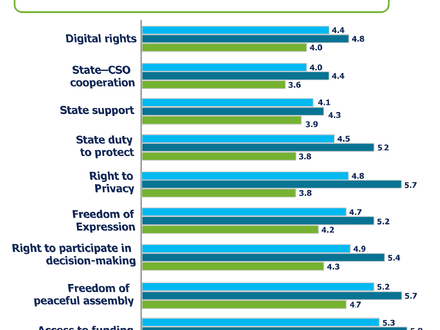
In 2025, the top three areas with the highest scores also remained consistent. However, three areas, Freedom of Expression, Right to Privacy, and Digital Rights, registered score decrease compared to 2024."
The year 2025 saw significant institutional developments aimed at aligning the country's governance with EU integration goals, particularly Armenia adopted the Law on Initiating the Process of Armenia’s Accession to the European Union, reflecting the government’s political will as well as being a strategic move towards integrating Armenia with the wider EU, as well as continued EU visa liberalisation negotiations.
However, despite these advances, the CSO sector faces significant challenges. The abrupt end of major U.S. assistance programs in 2025 created a financial vacuum, forcing many watchdog CSOs and independent media outlets to scale back or shut down. Meanwhile, domestic sources of funding continue to represent only a small share of CSOs’ income due to limited legislative incentives and an underdeveloped culture of local giving.
This lack of financial safety nets has left many smaller, community-based organizations vulnerable to closure. While EU-funded projects provide some opportunities, the high administrative capacity required to access these funds excludes smaller organizations from benefiting.
In the areas of Right to Participation in Decision-Making and State-CSO Cooperation, the legal framework for participation remains robust, with established mechanisms for consultation and dialogue. Positive developments include the creation of Department of Participatory and Open Governance issues within the Prime Minister’s Office, reflecting a high-level commitment to institutionalizing dialogue with civil society. Furthermore, a new strategic management procedure for national policies was introduced, embedding transparency and participation more firmly into government decision-making processes. However, the “implementation gap” persists, as CSOs are often heard but not meaningfully empowered to influence final decisions. Although the government has committed to deepening cooperation with civil society, the limited impact of CSO input and the insufficient implementation of their recommendations continue to frustrate many organizations.
A key area of concern remains the protection of civil society actors covered under the area State Duty to Protect. The state's approach to protecting freedom of speech and civic engagement remains inadequate, exposing organizations and individuals to legal and political risks, while CSOs working in sensitive areas continue to face harassment and threats. The rise of SLAPPs (Strategic Lawsuits Against Public Participation) exemplifies the increasing efforts by state and corporate actors to suppress dissent. The ongoing cases against environmental activists by major mining companies serve as a prominent example, illustrating the "chilling effect" such lawsuits have on activists, who are often deterred from challenging powerful interests.
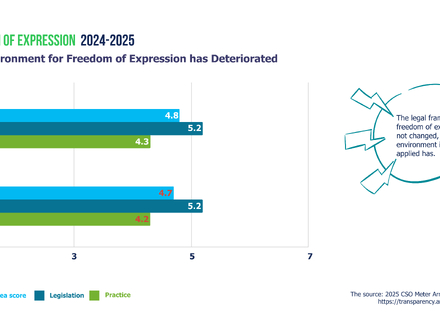
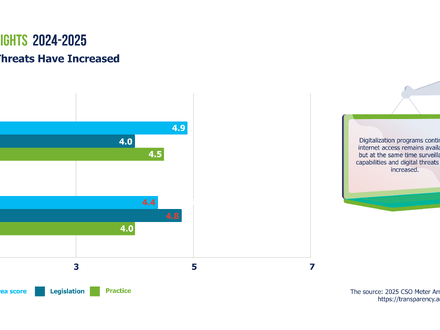
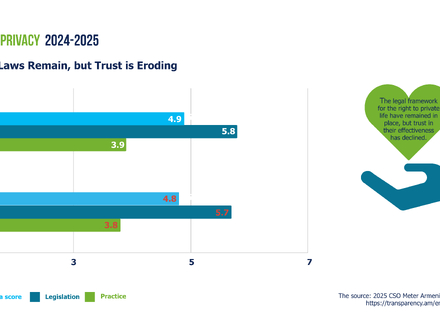
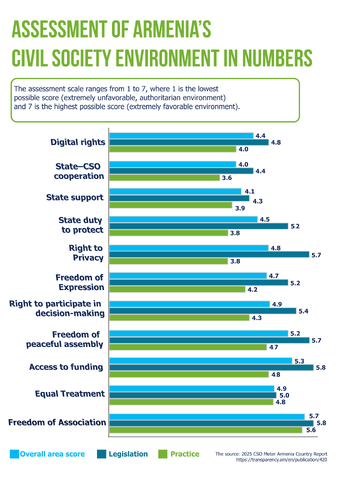 The article will separately focus on the main areas that have regressed in 2025 compared to 2024, particularly highlighting developments in Freedom of Expression, Digital Rights, and Privacy.
Below, you will find the main areas that have regressed compared to 2024, with a particular focus on developments in Freedom of Expression, Digital Rights, and Right to Privacy
Freedom of Expression
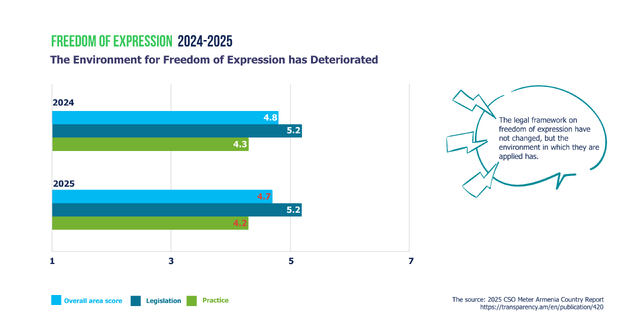
In the realm of free speech, the legal framework remains liberal, but the environment has grown increasingly toxic. While no new censorship laws emerged in 2025, the climate of public discourse is marred by polarization. CSOs noted that the legislation aimed at addressing hate speech and incitement to violence was applied selectively, with law enforcement bodies often prioritising the protection of government officials over CSOs, vulnerable social groups, and critics targeted by hate speech, harassment, and defamation.
The Committee to Protect Freedom of Expression documented a rise in defamation suits against media and journalists, often filed by state actors. Independent outlets like CivilNet and Radio Liberty continue to face hostility, while the funding by the state’s new media foundation aimed at supporting “public benefit” content excludes online media, a move critics view as a missed opportunity to support media diversity. In this climate, a quiet spread of self-censorship is becoming a survival tactic for many civic actors.
 Digital Rights and Cybersecurity
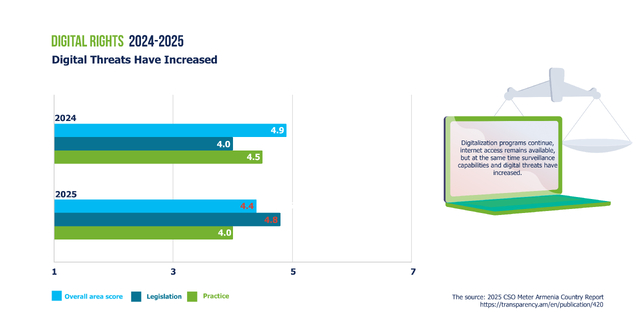
The landscape of digital rights in Armenia has evolved significantly in recent years, as the country becomes increasingly connected through digital platforms. While Armenia has made strides in modernizing citizen-state interactions, such as through the YES EM identification system and Hartak.am for e-services, this digitalization has brought new challenges. CSOs, journalists, and activists are increasingly vulnerable to cyberattacks and threats of surveillance. ՝ The adoption of a new legislative package in December 2025 established a comprehensive legal framework for addressing cybersecurity issues; however, its implementation remains to be seen. has left many digital rights defenders exposed to sophisticated cyber threats. While the government continues to promote digital connectivity, the protection of digital rights has not kept pace, making the country’s civic space more precarious for online activists and organizations.
Right to Privacy
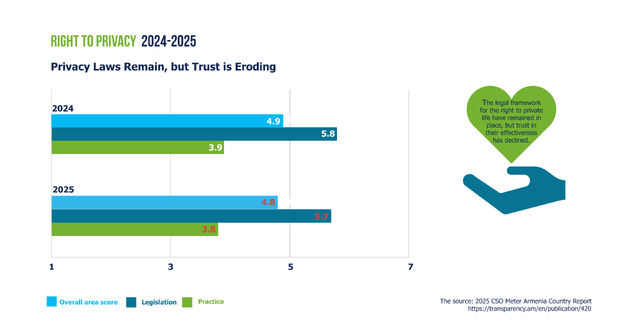
Privacy rights in Armenia took a concerning turn in 2025 with amendments to the Law on Police, which granted the Ministry of Internal Affairs expanded access to surveillance camera networks. Although the law includes provisions aimed at protecting citizens’ privacy, the absence of independent oversight remains a significant concern. Privacy advocates argue that the law’s implementation could lead to a rise in state surveillance, potentially infringing on the personal freedoms of individuals, including civil society members and activists. Without stronger checks and balances, and given the multiple cases of unlawful surveillance and leaked intimate video or wiretap recordings in practice, the right to privacy in Armenia faces increasing risks, particularly as the government's digital infrastructure continues to expand.
 Conclusion
Armenia’s civil society stands at a critical crossroads, where the government’s legal reforms, which are designed to promote participation and cooperation, represent important steps forward. However, the transition from legal frameworks to practical influence remains a persistent challenge. Despite existing and new legal provisions promoting participation, CSOs continue to struggle in turning consultation into tangible change. Financial instability, insufficient protection mechanisms, and selective law enforcement undermine the reforms, and the government's ambivalent approach, treating civic actors more as political risks than strategic partners, hinders progress. For Armenia to move beyond “progress on paper” and create a thriving, protected civic space, it must shift its perception of civil society. If non-democratic forces come to power as a result of the elections expected on June 7, this could negatively affect all the areas discussed above. Such a shift may further weaken civic participation, restrict fundamental freedoms, reduce state accountability, and deepen the risks already facing CSOs. The future of Armenia’s democracy, whether it develops into a resilient, genuinely democratic system or remains a “managed democracy,” depends on whether the government embraces civil society as an essential partner in the country’s democratic survival.
The source: 2025 CSO Meter Armenia Country Report
https://transparency.am/en/publication/420