
Presentation of CSO Meter 2023 Armenia Report
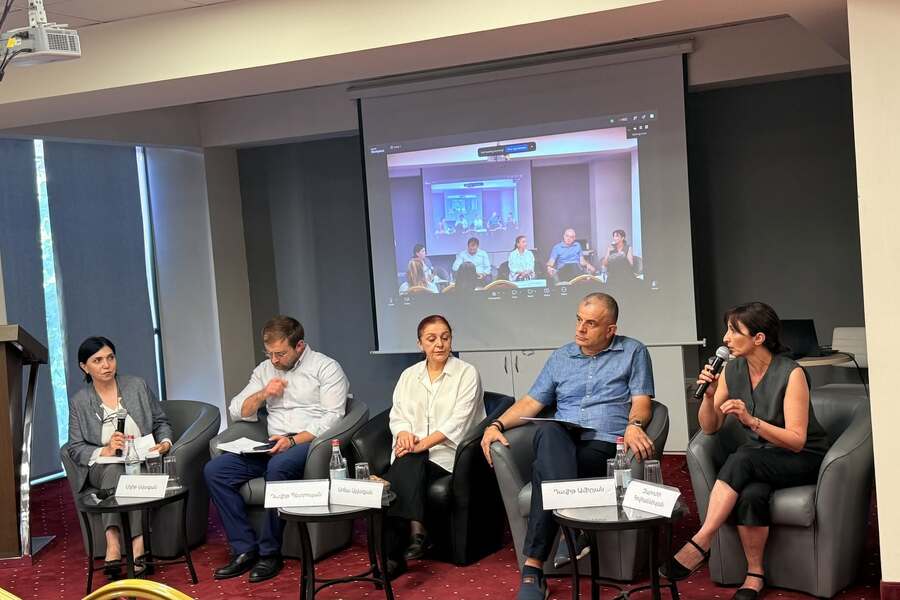
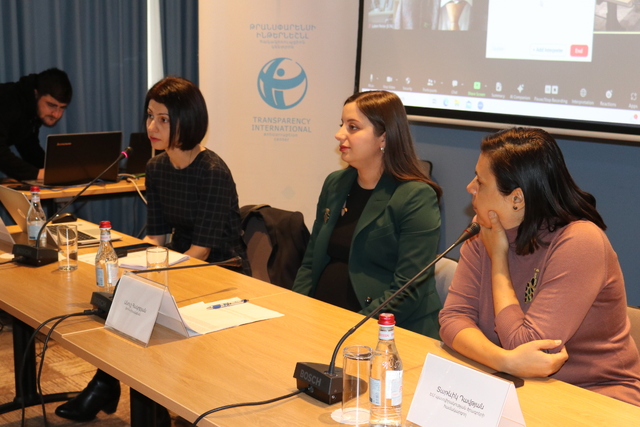
On December 13, the Transparency International Anticorruption Center organized the public presentation of the CSO Meter 2023 Armenia report. The event was attended by representatives of the European Union Delegation to Armenia, deputies of the National Assembly, state bodies, international and local non-governmental organisations.
The presentation was organised within the framework of the Action ‘CSO Meter: A Compass to Conducive Environment and CSO Empowerment’ implemented with the financial support of the European Union and implemented by the European Center for Not-for-Profit Law Stichting (ECNL), Transparency International Anticorruption Center (TIAC) and other partners from Eastern Partnership countries.
The research on civil society enabling environment in Armenia is based on a joint methodology for Eastern Partnership countries – CSO Meter tool. It consists of a set of standards and indicators in 11 different areas to measure both law and practice and is based on a review of international standards and best regulatory practices. The research is conducted on annual basis since 2019.
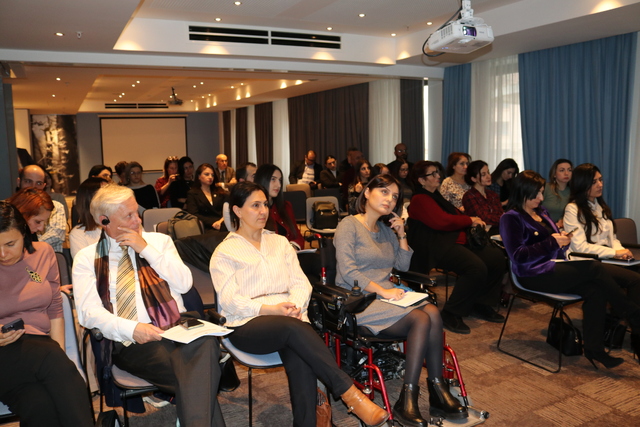 The main purpose of the event was to present the findings and recommendations for priorities for legislative and practice changes, based on the CSO Meter research for 2023. The opening remarks were given by Tatevik Davtyan, Programme Officer of the European Union Delegation to Armenia, and Luben Panov, ECNL Senior Program Advisor. Tatevik Davtyan mentioned that the CSO Meter is a useful tool enabling to continuously follow the improvements taken place in the CSO enabling environment and identify the existing challenges and gaps. Luben Panov presented the global trends in the CSO environment in 2023, including both positive developments and challenges. He mentioned that the adoption of the Law on Voluntary Work in Armenia was an achievement as thanks to the efforts of CSOs, the adopted regulations were far more positive and enabling as compared to the initial draft.
 TIAC representatives Anush Hakobyan and Tatevik Margaryan presented the main findings of the 2023 CSO Meter.
The overall score for the CSO environment in Armenia did not change in 2023 as compared to 2022 (4.8 out of 7). The top three areas with the highest scores remain the same compared to 2022: Freedom of Association (5.7), Access to Funding (5.3), and Freedom of Peaceful Assembly (5.3), while the areas with the lowest scores are State-CSO Cooperation (4.0), State Support (4.1), State Duty to Protect (4.5) and Digital Rights (4.5).
Several important developments were noted in some of the areas analysed. The main development, which concerns both the areas of Freedom of Association and State Duty to Protect is the requirement to declare ultimate beneficial owners (UBOs) of CSOs, which entered into force in 2023. A problem of perception of the beneficial ownership institution is noted among CSOs, while reporting the changes in the data of beneficial owners brings additional costs. Due to this, as well as the continuing lack of effective protection of CSOs working in sensitive areas, a deterioration was noted in the score of State Duty to Protect (from 4.6 in 2022 to 4.5 in 2023).
An important problem identified in Access to Funding is the interpretation of grant projects as ‘delivery of services’, thus subject to charging VAT in cases where the recipient CSO becomes a registered VAT payer when reaching the defined threshold of annual turnover. This might lead to limitation of access to funding in practice; thus, despite a generally enabling environment for CSOs to seek funding from diverse sources, the overall score for Access to Funding has deteriorated (from 5.4 in 2022 to 5.3 in 2023).
In the area of the Right to Participation in Decision-Making, an improvement in the legislation score was noted due to the adoption of the roadmap for the implementation of Public Administration Reform Strategy and a results framework for 2023-2025, as well as the revised Open Government Partnership (OGP) Action Plan. These documents set out further actions on public participation improvement, including the formation of an institutional mechanism for monitoring and maintenance of participatory management procedures and advancing online and offline tools and mechanisms for participatory governance. Therefore, the overall score in this area improved (from 4.8 in 2022 to 4.9 in 2023). However, a deterioration in terms of access to information was reported, taking into account the continuing practical challenges in getting information from the authorities and an additional category of restricted information (‘official information of limited distribution’) introduced in the Law on State Secrecy and the Law on Freedom of Information.
In the area of Freedom of Expression, despite the Government and media organisations working together on the concept of media reforms, several media-related drafts were not properly consulted on with CSOs in 2023. Lawsuits against media and journalists on the grounds of defamation and insult continue to be at a high rate, with high levels of compensation imposed․ In addition, a number of lawsuits against individuals on the basis of their social media posts were initiated. Hence, the practice score in this area has deteriorated, resulting in a decrease of the overall area score (from 4.8 in 2022 to 4.7 in 2023).
 An improvement was reported in the legislation score for State Support due to the adoption of the Law on Volunteer Work, aimed at regulating the concept of volunteering and protecting volunteer rights. At the same time, the challenges related to state funding and the lack of an encouraging tax environment for CSOs and donors remain in place, thus the overall area score remains the same as in 2022 (4.1).
No score changes were reported in other areas of CSO Meter. In the area of Equal Treatment, unequal access for CSOs compared to businesses in terms of registration and taxation of economic activities remains the same as in previous years. The problems in the area of Freedom of Peaceful Assembly also persist, as incidents of violations of assembly participants’ rights and the lack of accountability of police officers for previous incidents continued to be the main challenges in the area. While Armenian legislation provides guarantees for the protection of the Right to Privacy, there is a need for improvement taking into account modern technologies and their related risks in terms of personal data management and security. The lack of oversight or of accountability mechanisms for surveillance activities is also considered a major practical challenge in this area.
There is no specific policy or strategy on CSO development or State-CSO Cooperation, though various national strategies and legislative provisions determine principles of participation and cooperation. Based on TIAC’s negotiations with the Government, discussions around specific components of the CSO enabling environment were organised by the Office of the Prime Minister. The challenges in the functionality and effectiveness of public councils and other consultative bodies remain the same as in previous years.
The Government has taken a number of steps in 2023 towards better media literacy, internet accessibility, and the promotion of digital standards, which together enable greater protection of Digital Rights. Use of technology for surveillance purposes is properly regulated by law and restricted for a narrow set of purposes. There is, however, evidence of unlawful surveillance of phone and electronic communications in practice.
The participants of the event mentioned that the report findings and recommendations are very useful and interesting, and help to get a good understanding of the civil society-related developments. Several participants had short remarks and questions on the report.
The second part of the event addressed one of the key issues for financial sustainability of the civil society in Armenia, which is the challenges and opportunities linked with the CSO taxation regulations. In particular, the issue of treating grant projects as economic activities which are subject to VAT was discussed. The participants expressed their concerns regarding the interpretation of grant projects as service delivery and the subsequent taxation. The practical issues related to VAT taxation, obtaining charitable status, and audit requirements faced by CSOs through their work were also discussed.
TIAC representatives thanked all participants and mentioned that the comments and remarks will be taken into account for finalising the report. The CSO Meter Armenia 2023 report will be available on the TIAC website by the end of the year.
-------------------------------------------------
The event was organised within the framework of the Action “CSO Meter: A Compass to Conducive Environment and CSO Empowerment“, implemented with the financial support of the European Union.
The Project is implemented by the European Center for Not-for-Profit Law Stichting (ECNL) and its partners: Transparency International Anticorruption Center in Armenia; MG Consulting LLC in Azerbaijan; Civil Society Institute in Georgia; Promo-LEX Association in Moldova; and the Ukrainian Center for Independent Political Research (UCIPR).